A newly built villa, a freshly painted flat or a room of new furniture has a smell of its own, and most people read it as a sign of something clean and untouched. It is actually the materials releasing chemicals into the air, a process usually called off-gassing. The smell fades over the first months, but not evenly, and the Saudi summer slows the fading in ways most people do not expect. This guide explains what the new home smell is, what the research says about how long it lasts, and when it makes sense to start scenting a new home.
What the new home smell actually is
Paint, adhesives, sealants, varnish, engineered wood, carpets, mattresses and upholstery all release volatile organic compounds, or VOCs, for some time after they are made or applied. The smell you notice is a mixture of many of them. One of the most studied is formaldehyde, which comes mainly from pressed-wood products such as MDF, chipboard and plywood, and from some glues and finishes.
The World Health Organization’s Guidelines for Indoor Air Quality: Selected Pollutants (WHO Regional Office for Europe, 2010) sets a guideline for formaldehyde of 0.1 mg/m³ averaged over any 30-minute period. WHO recommends it as the level that prevents sensory irritation of the eyes and nose in the general population, and says it also protects against long-term effects. The same document lists what drives indoor formaldehyde: the age of the building, because emission falls with time; temperature and relative humidity; the air exchange rate; and the season.
Your nose is not a measuring instrument
It is tempting to treat the smell as a gauge: if you can smell it, there is a problem, and once it has gone, the air is fine. Neither half holds. WHO notes that the odour threshold for formaldehyde is usually reported at 0.2–0.4 mg/m³, while a significant fraction of people can perceive it at or below 0.1 mg/m³. So one person in the house may smell it clearly while another notices nothing in the same room. Your own nose also adapts within minutes, which is why visitors notice a smell you stopped registering on the second day (we explain why in why you stop noticing home odours). If you need to know the level, it has to be measured.
How long off-gassing lasts
Most of the drop happens in the first year
The clearest long-term evidence comes from Jun-Seok Park and Koichi Ikeda, who monitored indoor air in new and older homes in Japan for three years (Indoor Air 16(2), 129–135, 2006). VOC levels in the new homes fell markedly within the first year and ended up close to those in the older homes. Formaldehyde and alpha-pinene, both linked to wooden materials, took noticeably longer to clear than the other compounds, particularly in wooden-framed houses.
Their second finding matters more for what you can do about it. The fall in the new homes did not depend on which ventilation system the house had. The authors concluded that indoor levels were driven more by the materials ageing and emitting less than by ventilation, while also noting that adequate ventilation is what lets those falling emissions actually leave the house.
Refurbishment counts too
A new building is not the only source. WHO reports that in roughly 6,000 recently refurbished dwellings in urban China, measured between 1999 and 2006 within a year of remodelling, mean formaldehyde was 238 µg/m³, more than twice the 100 µg/m³ that China allows in residential buildings. A kitchen refit, new built-in wardrobes or a room of flat-pack furniture can bring the smell back to a house that lost it years ago.
Why the Saudi summer slows it down
Emissions from building materials rise with temperature and humidity. Jianyin Xiong and colleagues modelled the combined effect (Environmental Research 151, 734–741, 2016) and predicted that indoor formaldehyde in a Beijing summer would be about 1.63 times the winter level, roughly in line with survey data. A study of 63 recently built California homes by Lawrence Berkeley National Laboratory (Zhao et al., International Journal of Environmental Research and Public Health 19(11), 6603, 2022) also built temperature and humidity into its model of how fast homes emit formaldehyde.
Neither study was done in the Gulf, so read the direction rather than the numbers. What it means here is simple. A house handed over in June, sealed against 45-degree heat with the air conditioning recirculating the same air, has the conditions that raise emission and the conditions that keep it inside. Furniture delivered in a sealed container, or a wardrobe that sat in a hot storeroom, will usually smell strongest in its first weeks indoors. We cover the wider effect of heat and humidity on how a home smells in home fragrance in the Saudi climate.
What actually helps
Ventilate in the cooler hours
Ventilation will not stop materials emitting, but it removes what they emit. Open windows on opposite sides of the house early in the morning or late in the evening, when the outside air is cooler and the sand is calm. If your air conditioning has a fresh-air intake, make sure it is open rather than set to full recirculation. Run bathroom and kitchen extractors for longer than you normally would during the first weeks.
Unwrap early and let new furniture breathe
Take new furniture and mattresses out of their plastic as soon as they arrive, and if you have space, leave them in a well-ventilated room for a few days before they go into a bedroom. Close doors on freshly painted rooms and ventilate them separately rather than letting the smell spread through the house. If you are still choosing materials, ask suppliers for low-emission paint and furniture. WHO lists low-emitting materials as the first line of prevention.
What does not work
House plants are often recommended for “cleaning the air”, and the evidence says otherwise. Bryan Cummings and Michael Waring reviewed 196 results from 12 chamber studies (Journal of Exposure Science and Environmental Epidemiology 30(2), 253–261, 2020). A single potted plant removed a median of 0.023 m³ of air’s worth of VOCs per hour. Matching the cleaning that ordinary air exchange already provides would take 10 to 1,000 plants per square metre of floor. Plants are good to live with, but they are not ventilation.
Fragrance does not remove VOCs either. A strong air freshener only adds its own compounds to the air and stops you noticing the smell of the materials, which is exactly the signal you want to keep while the house is still clearing.
When to start scenting a new home
Our advice is to wait until the materials smell has faded noticeably, not to use fragrance to cover it. In most homes that means after the first few weeks of heavy ventilation, and later in a nursery or any room with a lot of new pressed-wood furniture. When you do start:
- Begin in the living areas and the majlis, where people gather, rather than in bedrooms.
- Start on the lowest setting and short cycles, and raise it only if the scent is not noticed after a week.
- Choose a cold-air diffuser over candles or burners in a new home. Combustion adds particles and gases of its own (we compare the formats in candles vs room sprays vs diffusers).
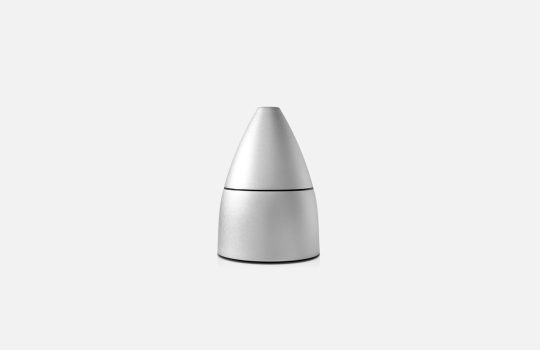
- Size the diffuser to the room, not to the house. An Aromax is rated for 250 m³, which covers a large living room; open-plan villas and long ground floors are what the 1,000 m³ AroSlim is for. Our diffuser sizing guide shows the arithmetic.
A new home is also a good moment to decide on a scent deliberately rather than by accident. Our fragrance collection is grouped by family, and a light, fresh profile is the easiest to live with in the first months.
What we will not claim
We are not able to tell you whether the air in your home is safe. Only a measurement can do that, and if anyone in the house has asthma, is pregnant, or is reacting to the new home with headaches or eye irritation, a professional indoor-air test is worth more than any advice here. Nor will we tell you that fragrance “neutralises” off-gassing. It does not. For how we approach fragrance safety in general, read is scent diffusion safe?
Frequently asked questions
How long does the new home smell last?
It fades over months rather than days. A three-year study of new homes in Japan found VOC levels fell markedly within the first year and approached those of older homes, but formaldehyde and other wood-related compounds took longer. Heat, humidity and closed windows slow the process.
Is the smell of new furniture harmful?
The smell itself cannot tell you. It comes from compounds released by the materials, including formaldehyde, for which WHO sets a guideline of 0.1 mg/m³ over 30 minutes. Some people smell formaldehyde below that level and others do not smell it above it, so only a measurement can tell you the concentration.
Does hot weather make off-gassing worse?
Yes. Emissions from building materials rise with temperature and humidity, and one modelling study predicted summer formaldehyde levels about 1.6 times higher than winter. In Saudi Arabia, a house kept sealed with recirculated air conditioning in summer both emits more and holds more of it inside.
Do plants remove the new home smell?
Not in any useful amount. A 2020 review of 12 studies calculated that you would need between 10 and 1,000 potted plants per square metre of floor to match the effect of ordinary ventilation. Open windows in the cooler hours instead.
When can I start using a diffuser in a new home?
Once the materials smell has faded noticeably, usually after the first few weeks of ventilation and later in nurseries. Start in living areas on the lowest setting, use a cold-air diffuser rather than candles, and do not use fragrance to cover the smell while the house is still clearing.