
Ask most scenting suppliers about a large space and the answer arrives before the question finishes: integrate a unit into your central air conditioning. It is the bigger sale, and it sounds like the serious, professional option. For a good number of the villas, showrooms and offices that ask, it is also the wrong answer — an expensive solution to a problem a standalone device already solves. This guide covers how to tell which situation you are in.
What duct integration actually buys you
Integrating scent into central HVAC means mounting a unit onto the air handler or supply duct so fragrance is carried through the existing ductwork to every outlet in the building. The appeal is obvious: one device, uniform coverage, nothing visible in the rooms.
The cost is less obvious. Integration ties scent distribution to the air conditioning schedule — when the AC is off, so is the scent. It requires access to the plant room and usually an HVAC contractor. In an office building that matters more than it sounds, because reception and the open-plan floors want very different intensities — see our guide to scenting an office. And it makes per-zone control harder, because every outlet on the same trunk gets the same fragrance at the same intensity. A showroom and its back office end up smelling identical whether you wanted that or not.
The question that actually decides it
Not floor area — air zones. Ask how many separately conditioned areas the building has, and whether they need to smell the same.
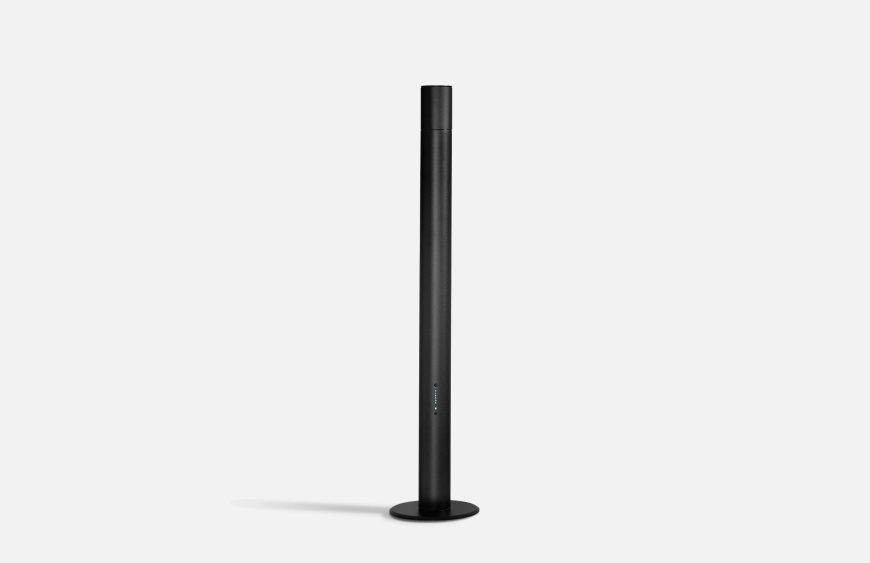
One open volume on one AC circuit is the case where a standalone device wins outright. It reaches the whole space, costs a fraction of an integration project, moves if you rearrange the room, and runs on its own schedule regardless of whether the AC is cooling. The AroSlim covers up to 1,000 m³ as a standalone unit — a 250 m² showroom with 4 m ceilings is 1,000 m³, and sits inside that on a single device.
Where standalone stops making sense
Three signals point genuinely towards integration.
Multiple floors or many separated rooms
Scent does not travel through walls or between storeys. A building with fifteen closed offices across three floors needs fifteen points of delivery, and at that count ducted distribution becomes the cheaper and tidier answer than fifteen devices.
Total volume well beyond a single unit’s coverage
Above roughly 1,000 m³ in one connected volume — large hotel lobbies, atriums, full-floor retail — you are either running several standalone units or integrating. Which is better becomes an arithmetic question about device count, placement and who maintains them.
Nothing may be visible
Some interiors will not accept a device in the room at all. That is a legitimate reason to integrate on its own, independent of size.
Sizing before you buy anything
Whichever route you take, the number that matters is volume in cubic metres: length × width × ceiling height, per conditioned area, added up. Saudi commercial ceilings run high, and specifying from floor area alone routinely under-sizes a system by half.
Two more factors adjust that figure. Heavy footfall and frequently opening doors both pull scented air out and dilute what is left, so entrances and lobbies need more output than their volume alone suggests. High ceilings also stratify — warm scented air rises, and in a tall atrium a good share of your output ends up above head height where nobody is standing.
A middle path most buyers miss
Zoned standalone units are frequently the better answer for buildings in between: an Aromax at 250 m³ in each of the areas that matter, rather than one integrated system pushing the same fragrance everywhere. It costs less than integration, it lets the lobby smell different from the workspace, and it can be changed one room at a time.
For genuinely large facilities — hotels, malls, multi-building compounds — the honest answer is that no article can specify the system. That is a site survey: duct layout, air-change rates, zone mapping. Talk to us with your drawings rather than buying from a coverage figure.
Before committing either way, our sizing guide covers the volume calculation in detail, and our cost breakdown shows what a standalone unit comes to over a year.
Scenting a commercial space?
Tell us your floor area and the type of venue, and one of our scent consultants will come back to you within one business day with a system recommendation, fragrance options and the monthly running cost — in writing, with no obligation.
Frequently asked questions
Does scenting have to be connected to the air conditioning?
No. For a single conditioned area within a device’s coverage, a standalone unit reaches the whole space at a fraction of the cost and keeps its own schedule. Integration earns its cost with multiple floors, many separated rooms, or volumes beyond what one device covers.
What size space does the AroSlim cover?
Up to 1,000 m³ as a standalone device — roughly a 250 m² space with 4 m ceilings. It is not an in-duct product; it works as a freestanding unit within one connected volume.
How do I calculate the size I need?
Multiply length by width by ceiling height for each conditioned area and total them. Use cubic metres, never square metres. Then allow extra output for entrances, high-traffic areas and tall ceilings, where scent disperses faster.
Will one fragrance suit the whole building?
With ducted integration, every outlet on the same trunk delivers the same fragrance at the same intensity. If a reception and a workspace need to feel different, zoned standalone devices give you that control and integration does not.
